

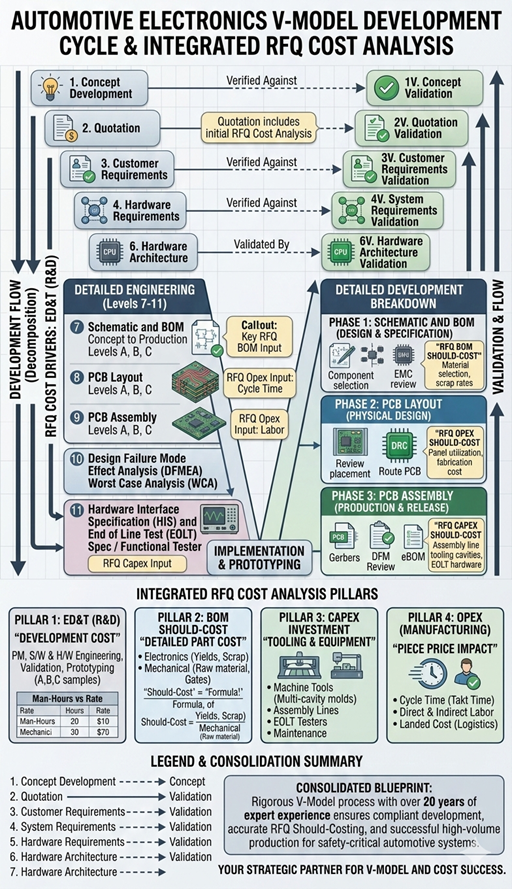
In the hyper-competitive world of automotive, securing a major contract often comes down to two numbers on a Request for Quotation (RFQ): your target price and your internal cost. For intricate mechatronic parts combining mechanics, electronics, and software, performing an accurate RFQ cost analysis is not just about submitting a bid; it’s a vital strategic exercise in “should-costing”. This process determines the logical, efficient cost a part should have, preventing you from overbidding and losing the business, or underbidding and crippling your profitability.
This blog will break down the essential pillars of RFQ cost analysis for high-volume automotive mechatronics, ensuring your bids are built on a solid foundation of data and proven methodology.
The Four Pillars of Automotive RFQ Cost Analysis
For mechatronic parts, which integrate mechanical, electronic, and software components, a multidimensional analysis is required. Your “should-cost” model must meticulously account for every aspect of the product life cycle.
- R&D / ED&T (Engineering, Design, and Testing)
This isn’t just about raw development hours; it’s a deep dive into engineering complexity. You must calculate total hours for each specialized department and multiply by the appropriate regional or internal labor rate:
• Project Management: A critical layer, typically calculated as 10–15% of the total engineering hours.
• Systems & Software Engineering: This is often the largest single cost driver for mechatronics. Your analysis must account for the immense effort of requirement analysis, coding, and the complex Hardware-in-the-Loop (HIL) testing required for safety-critical systems.
• Hardware (Electronics) Design: Covers the specific engineering tasks of schematic entry, PCB layout, and the crucial EMC (Electromagnetic Compatibility) simulation hours.
• Mechanical Design: Includes hours for CAD modeling, and critical performance simulations like Thermal (CFD) and FEA (Finite Element Analysis).
• Validation & Testing: A massive but necessary expense. Account for lab time and engineering hours for both DV (Design Validation) and PV (Performance Validation), covering extreme tests for vibration, thermal shock, and salt spray.
• Prototyping: Crucially, factor in the costs for producing A, B, and C-sample builds. These iterative prototypes often have significantly higher per-unit costs than final series production due to low volume and specialized tooling. - The Detailed Bill of Materials (BOM) Should-Cost
When dealing with high-volume production (e.g., 100k+ units/year), a “close enough” guess on material costs is a disaster waiting to happen. Your BOM analysis must be meticulous, accounting for every single piece of the assembly:
• Electronic Components: Use current market indices for core components like MCUs, MLCCs, and PCBs. However, don’t just calculate the price of a component on a reel. You must also account for a “scrap rate” (typically 1–2%) during the manufacturing process. If you need 100,000 components to ship, you must buy and cost 102,000.
• Mechanical Parts: A deep dive into fabrication is required. For injection-molded or die-cast parts, don’t just calculate the weight of the finished product. You must also calculate the total raw material required, including the “gate” or “runner” material that gets trimmed off during production.
• Purchased Parts: Identify costs for sub-assemblies like wire harnesses, sensors, or special connectors sourced from Tier-2 suppliers. - Capex and Tooling: The High-Stakes Investment
This category represents the substantial up-front investment required to enable high-volume manufacturing. These costs are either paid as a one-time charge by the customer or amortized over the first year of production:
• Machine Tools: Focus on the critical, high-cavity tools needed for high-volume efficiency. Molds for plastic injection or dies for die-casting must be multi-cavity (e.g., 4-cavity) to meet cycle time and production volume targets.
• Assembly Lines: Costs for SMT (Surface Mount Technology) lines, dedicated automated screw-driving stations, or high-precision laser welding equipment.
• EOLT (End of Line Testing): Specialized, complex functional testers. In automotive, every single produced unit must pass these EOL tests before being cleared for shipment to the customer.
• Maintenance: Always include an annual maintenance cost, typically calculated as 3–5% of the total initial tooling cost. - Opex and Manufacturing: The Cost of Doing Business
This pillar moves from development and material into the day-to-day cost of running the production line:
• Cycle Time (Takt Time): This is perhaps the most critical metric in high-volume costing. A seemingly minor difference in cycle time—like 30 seconds vs. 40 seconds—has a massive impact on capacity. If you need to make 1 million parts a year, that 10-second difference dictates whether you can meet demand with one shift or if you require an expensive three-shift operation.
• Labor: Distinguish between direct labor (the actual assembly operators) and indirect labor (logistics, material handlers, and quality control personnel).
• Logistics & Packaging: Don’t overlook the “Landed Cost”. Account for shipping, duty, and the difference between cheap disposable packaging and the complex management of expensive returnable containers.
Master the Methodology: Resources and Analysis Summary
To perform this level of deep costing, you must leverage industry-standard methodologies. These “bibles” of cost estimation provide the quantitative tools required:
- “Cost Estimation: Methods and Tools” by Gregory K. Mislick and Daniel A. Nussbaum: A vital guide to academic and practical quantitative costing techniques.
- “Integrated Product and Process Design and Development” by Edward B. Magrab: Crucial for understanding how fundamental design choices—like the integration of mechatronic components—directly impact Capex investment requirements.
- VDI 2235 Guideline: The German Engineering Standard specifically for “Economic efficiency of products and processes”.
RFQ Analysis at a Glance: Key Calculations
Category Key Metric Calculation Base
Development Man-Hours Dept. Headcount × Project Weeks × Hourly Rate
BOM Unit Cost (Raw Material + Process Cost) × Yield Rate
Capex Total Investment Tooling + Testing Equipment + Assembly Automation
Opex Piece Price Impact (Direct Labor + Energy + Overhead) / Annual Volume
[Image: Automotive Mechatronic Cost Breakdown Structure]
For an excellent example of this methodology in action, we recommend watching this professional overview of “Should Cost Analysis” applied to manufacturing: Understanding Should Cost Analysis.
Performing a robust RFQ cost analysis is your single best tool for competitive, profitable, and successful automotive business acquisition. By rigorously applying these four pillars, you can submit your bids with confidence, knowing every number is backed by data, methodology, and a complete understanding of your mechatronic product lifecycle.
RFQ Analysis at a Glance: Key Calculations
| Category | Key Metric | Calculation Base |
| Development | Man-Hours | Dept. Headcount × Project Weeks × Hourly Rate |
| BOM | Unit Cost | (Raw Material + Process Cost) × Yield Rate |
| Capex | Total Investment | Tooling + Testing Equipment + Assembly Automation |
| Opex | Piece Price Impact | (Direct Labor + Energy + Overhead) / Annual Volume |
[Image: Automotive Mechatronic Cost Breakdown Structure]
For an excellent example of this methodology in action, we recommend watching this professional overview of “Should Cost Analysis” applied to manufacturing: Understanding Should Cost Analysis.
Performing a robust RFQ cost analysis is your single best tool for competitive, profitable, and successful automotive business acquisition. By rigorously applying these four pillars, you can submit your bids with confidence, knowing every number is backed by data, methodology, and a complete understanding of your mechatronic product lifecycle.