

In the modern automotive landscape, the cabin experience is just as crucial as the powertrain. One element that has seen dramatic growth in significance is ambient lighting. No longer a simple garnish, advanced ambient lighting must now be dynamic, functional (integrated with ADAS), and perfectly reliable in safety-critical contexts. This complexity demands a robust development framework.
Enter the V-Model Development Cycle—the essential blueprint for transforming a concept into a safe, certified automotive electronics system. At our company, we have pioneered this specialized workflow for decades, providing deep expertise to guide you flawlessly through every logical, physical, and validation step required for advanced ambient lighting success.
Here is a detailed breakdown of the critical phases and the comprehensive support we offer across the entire V-Model:
The Decomposition Flow: Defining and Designing the Light
The left side of the “V” is all about defining the problem and designing the solution, moving from high-level requirements to detailed component specifications. For an advanced ambient lighting system, this must seamlessly integrate mechanical, electronic, and software engineering.
Phase 1: Establish the Vision (Concept & Requirements)
A successful product starts with a crystal-clear vision. We help you define “what” you are building:
• Concept Development: Crystallize the core function, from a simple glow to full dynamic integration.
• Quotation: Create a clear, compliant quotation, backed by rigorous initial RFQ Cost Analysis.
• Customer & System Requirements: Meticulously document every need and functional specification.
Phase 2: Architect the Solution (Hardware Design)
Next, we dive into the technicalities, defining “how” the system will be built to last and function perfectly:
• Hardware Requirements & Architecture: Define the technical specifications and the structural blueprint.
• Detailed Engineering Phase (Schematic, BOM, PCB Layout): This is the core engine of design. We handle all specialized tasks, including Schematic Entry, expert Component Selection optimized for automotive grade, and PCB Layout across all prototype levels (A, B, and C).
• Safety & Reliability Analysis: Crucial for automotive. We perform rigorous analyses, including Design Failure Mode Effect Analysis (DFMEA) and Worst Case Analysis (WCA), along with defining precise Hardware Interface Specifications (HIS) and End-of-Line Test (EOLT) Specifications. This defines “how” it will be built to last.
The Base of the “V”: Realizing the Hardware
theoretical plans become a physical reality:
• PCB Assembly: This is where components meet the board, turning designs into testable, lighting-ready hardware.
The Integration & Test Flow: Validating the Experience
The right side of the “V” is all about testing your physical prototypes against the specifications defined on the left side, ensuring flawlessly compliant performance.
Phase 3: Prove the Parts (Component & Analysis Validation)
We don’t just build; we verify:
• Component & Analysis Validation: We validate the DFMEA and WCA results to ensure all potential risks have been mitigated before system-level builds.
• Detailed Design Validation: Comprehensive validation of the Schematic, BOM, PCB Layout, and Assembly. Your lighting prototypes (A, B, C levels) are physically and functionally tested to ensure they meet every expectation.
Phase 4: Validate the Whole (System Testing)
Testing now scales up to ensure all parts work perfectly together in a complete system:
• Integration Testing: We test your validated hardware against the Hardware Architecture and Hardware Interface Specifications (HIS), ensuring all mechatronic components play together perfectly.
• Final System Validation: The last critical hurdle. We validate the EOLT Specifications and confirm that your entire ambient lighting system meets all original System and Customer Requirements. Only then can you move to full production with confidence.
Your Strategic Partner for Lighting, V-Model, and Cost Success
Navigating this complete cycle on your own, especially with high-volume mechatronic components that carry complex cost drivers, can be resource-intensive. This is not a journey you should take alone.
With over 20 years of expert experience in automotive mechatronics and safety-critical systems development, we are your dedicated, expert partner. We understand the pressure to innovate while ensuring safety, and we know exactly what is required at every single step of the V-Model. When you work with us, you don’t just get a consulting partner; you get a team of engineers and process experts who will help you achieve every step of the development and validation cycle, from robust documentation and detailed checklists to process development tailored to your project.
Ready to accelerate your automotive ambient lighting development and ensure flawless, compliant performance? Contact us today to discuss how we can partner to master your V-Model.
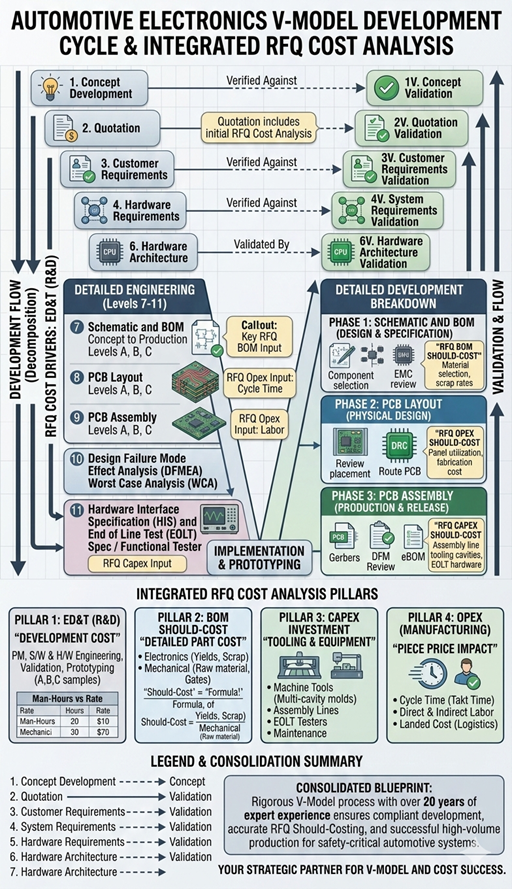
Consolidated V-Model Development Cycle & RFQ Cost Analysis for Automotive Electronics
To consolidate everything and provide a professional infographic to visualize this complex ecosystem, we have integrated the complete V-Model with the crucial elements of RFQ Cost Analysis. This diagram shows how your technical development decisions directly impact your cost pillars.
This comprehensive infographic map visualizes how the rigorous technical development and validation steps are supported by our expertise and directly connect to critical RFQ Cost Drivers like ED&T (R&D) and high-volume Should-Costing. It reinforces to your readers that we are the strategic partner capable of delivering both a flawless development process and a competitive, profitable product.