

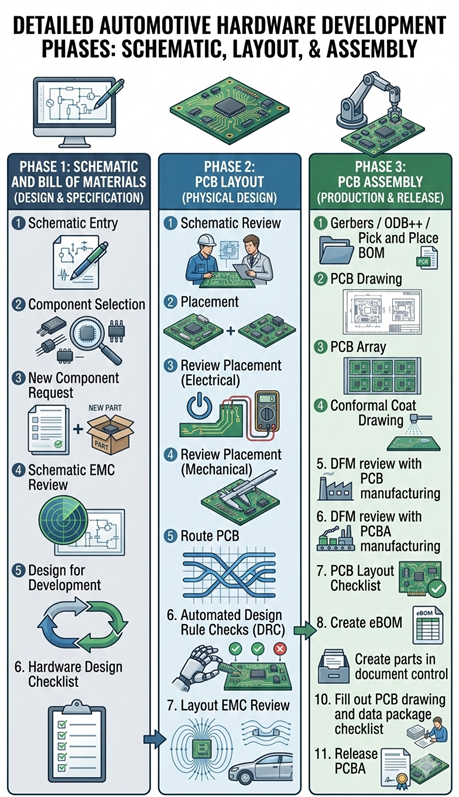
Navigating the landscape of automotive electronics development can be a daunting journey. The process demands unparalleled precision, strict adherence to safety standards, and a level of complexity that can easily overwhelm even experienced engineering teams. In the race to bring innovative, reliable, and compliant products to market, you cannot afford to skip a single beat.
At the heart of any successful automotive hardware project is the V-Model Development Cycle. This isn’t just a conceptual diagram; it is your essential blueprint, your map from the first spark of an idea to the finished, certified product. It is designed to ensure that every stage of development is meticulously validated against its corresponding requirements, preventing costly, last-minute failures.
But understanding the “what” of the V-Model is only the first step. The real challenge is the “how”—and that is where we come in.
Breaking Down the V-Model: The Development and Validation Sync
The beauty of the V-Model is its inherent logic. For every step you take in developing and detailing your system, there is a symmetrical step to validate and verify that specific piece of work. This approach dramatically reduces risk by catching errors early, when they are cheapest and easiest to fix.
Let’s walk through the key stages:
- Establishing the Foundation (Decomposition Flow)
The left side of the “V” is all about defining the problem and designing the solution, moving from high-level concepts to detailed implementation:
• Concept & Requirements: We help you crystallize your Concept Development, meticulously document Customer and System Requirements, and create a clear, compliant Quotation. This defines “what” you are building.
• Hardware Architecture & Detailed Design: Next, we dive into the technicalities, defining Hardware Requirements and architecture. Our expertise covers the entire detailed design phase, including Schematic & BOM creation and PCB Layout across all prototype levels (A, B, and C).
• Critical Analysis: We perform rigorous safety and reliability analyses, including Design Failure Mode Effect Analysis (DFMEA) and Worst Case Analysis (WCA), along with defining precise Hardware Interface Specifications (HIS) and End-of-Line Test (EOLT) Specifications. This defines “how” it will be built to last. - The Final Implementation (The Base of the V)
This is the transition from design to physical product, where theoretical plans become a reality:
• PCB Assembly: This is where components meet the board, turning designs into testable hardware. - Proving the Design (Integration & Test Flow)
The right side of the “V” is all about testing your physical or digital prototypes against the specifications defined on the left side:
• Component & Analysis Validation: We don’t just build; we verify. We validate your DFMEA and WCA results to ensure all potential risks have been mitigated.
• Detailed Design Validation: We perform comprehensive validation of the Schematic, BOM, PCB Layout, and Assembly. Your design is physically and functionally tested to ensure it meets your expectations.
• Integration Testing: We then test your validated hardware against the Hardware Architecture and Hardware Interface Specifications (HIS), ensuring all components play together perfectly.
• Final System Validation: In the final stages, we validate your EOLT Specifications and confirm that your entire system meets all original System and Customer Requirements. Only then can you move to full production with confidence.
We Are Your V-Model Acceleration Partner
Navigating this complete cycle on your own can be complex, resource-intensive, and fraught with compliance pitfalls. This is not a journey you should take alone.
With over 20 years of hands-on experience in automotive electronics development, our company is your dedicated, expert partner. We understand the pressure to innovate while ensuring safety, and we know exactly what is required at every single step of the V-Model.
When you work with us, you don’t just get a consulting partner; you get a team of engineers and process experts who will help you achieve every step of the development and validation cycle. Our support goes far beyond high-level strategy to include:
• Comprehensive Documentation: We don’t just advise; we create the robust, auditable documentation required for automotive-grade projects.
• Detailed Checklists: We develop and implement specific checklists for every phase to guarantee that no requirement is overlooked and compliance is built in from day one.
• Custom Process Development: We tailor the V-Model processes to your unique project needs, maximizing efficiency without sacrificing rigor.
Don’t let the complexity of the V-Model hold you back. Let’s build something extraordinary together.
Ready to accelerate your automotive electronics development and ensure flawless compliance? Contact us today to discuss how we can partner to master your V-Model.